Skip to header Skip to main navigation Skip to main content Skip to footer

Search form

Home
Questa New Mexico

Main navigation

  • Home

New Mexico History

Breadcrumb

  • Home
  • New Mexico History

The Vigas from Flag Mountain: How Questa Built Its First Church
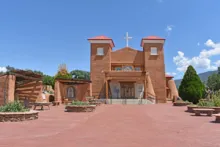
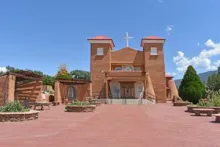
San Antonio de Padua Church in Questa, New Mexico, showing its adobe front, twin bell towers, and plaza

Did you know Questa's church began in the same year as the village itself? When 35 families received possession of the San Antonio del Rio Colorado land grant in January 1842, the village they founded took its name from Saint Anthony — San Antonio del Rio Colorado, Saint Anthony on the Red River. Construction of the San Antonio church began that same year, in 1842, and the first baptism records from Rio Colorado date to 1842 as well. This was no quick building project. The church would take years to finish, and that long, patient work is part of its story.
  • Read more about The Vigas from Flag Mountain: How Questa Built Its First Church

The Open Pit Years: When Questa's Mine Ran Around the Clock

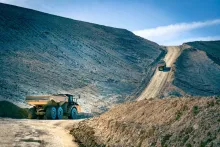
Haul trucks on the steep mine road crews called the Stairway to Heaven at the Questa molybdenum mine site, with waste rock piles alongside.

Did you know that for a time, Questa's molybdenum mine did not sleep at all? After the old high-grade underground veins ran out and underground mining ceased in the late 1950s, years of drilling told a new story. By 1964, exploration begun in 1953 had outlined a large tonnage of low-grade ore just west of the underground workings, ore that could be mined from the surface. It was a completely different kind of mine from the one Questa's first miners had known, and it would reshape work, and the mountain, for a generation.

  • Read more about The Open Pit Years: When Questa's Mine Ran Around the Clock

The Church They Rebuilt by Hand: St. Anthony's and the Heart of Questa

A photograph of St. Anthony Catholic Church in Questa, New Mexico, a twin-towered adobe church standing on its red plaza beneath a blue sky.

Sunday, November 1, 2026

Rain is falling over the valley this Sunday, with a high near 55 degrees, rain likely through the day, and sunset coming early at 5:05 PM now that the clocks have gone back. It is a good day to slow down, stay close to home, and look again at the place that has stood at the center of Questa longer than the village has carried its present name: the thick-walled adobe church on the old plaza, St. Anthony's.

  • Read more about The Church They Rebuilt by Hand: St. Anthony's and the Heart of Questa

From Sheep Herds to Cattle: Ranching and Farming in the Questa Valley

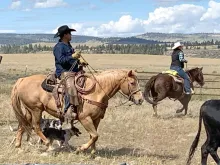
A photograph of Manuel and Libby Lucero gathering cattle near San Antonio Mountain, New Mexico.

Did you know Questa began as a village of sheep farmers? The first Questa-area settlers traveled to the Rio Colorado country on the Kiowa Trail between 1805 and 1818, driving their sheep with them, and by 1835 families were coming up from Taos to farm and graze sheep here through the summers. When the permanent village of San Antonio del Rio Colorado was founded in 1842, flocks were at the heart of it, and in the mid-1800s a wall built around the plaza offered the fledgling settlement of sheep farmers and traders a stability its people had not enjoyed before.

  • Read more about From Sheep Herds to Cattle: Ranching and Farming in the Questa Valley

El Oratorio: Questa's Small Chapel of Prayer and Farewell

Across from Questa's historic church, in the old cemetery, stands a small building with a singular place in village history: El Oratorio. It is Questa's only oratorio, a small private prayer chapel, and it has been in use since the 1800s.

An oratorio is a place set apart for prayer, smaller and more intimate than a church. Questa's stands outside the old plaza walls, in the cemetery grounds, a location that tells its own story. It was close to the heart of the old village, yet set apart in the place reserved for the dead, serving the community at the boundary between the two.

  • Read more about El Oratorio: Questa's Small Chapel of Prayer and Farewell

Questa's Acequias: Water Shared for Generations

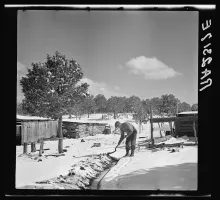
Arthur Rothstein's 1936 photograph of a man digging an irrigation ditch in Taos, New Mexico.

In Questa, water is life, and for generations that water has arrived the communal way: through acequias. These irrigation ditches carry water from the Red River and Cabresto Creek to the fields and gardens of the village, shared among neighbors under a tradition far older than the town's current name.

  • Read more about Questa's Acequias: Water Shared for Generations

NM 522: The Carlos R. Cisneros Memorial Highway

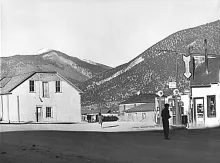
John Collier Jr.'s 1943 photograph of the highway junction in Questa, with a gas station and the J.A. Rael Hall.

Every drive north from Questa follows a road with layers of history under its pavement. Today that highway, NM 522, also carries a name that honors one of Questa's own: in 2022, it was named the Senator Carlos R. Cisneros Memorial Highway.

Carlos R. Cisneros was a Questa man who served 34 years in the New Mexico Senate, from 1985 to 2019. Thirty-four years is an extraordinary span of public service, covering decades of change in New Mexico. Naming the highway north from his hometown for him ties his long career in Santa Fe back to the road home to Questa.

  • Read more about NM 522: The Carlos R. Cisneros Memorial Highway

The Questa Molybdenum Mine: A Century of Work and Change

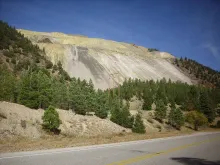
The tailings pile of the Questa molybdenum mine in New Mexico, seen from the road below.

For nearly a century, the molybdenum mine shaped life in Questa as surely as the river and the mountains. Molybdenum, the hard-to-pronounce metal at the center of the story, gave generations of local families work, and gave the village an industrial chapter alongside its older farming and ranching roots.

  • Read more about The Questa Molybdenum Mine: A Century of Work and Change

Before It Was Questa, It Was Rio Colorado

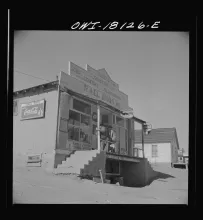
John Collier Jr.'s 1943 photograph of the Rael Bros. general store in Questa, New Mexico.

Before it was Questa, this village in northern New Mexico was Rio Colorado. Its story begins in the early 1800s, when the country along the river was a remote and exposed place to try to build a permanent home.

Around 1815, a Spanish military post stood here, and a land grant brought 50 families to the settlement. A land grant was a serious undertaking: families were expected to settle the land, farm it, and hold it. From the very beginning, Rio Colorado was a community built by families putting down roots in demanding country.

  • Read more about Before It Was Questa, It Was Rio Colorado

Sulphur Gulch: The Mistaken Mineral That Launched Questa's Mine

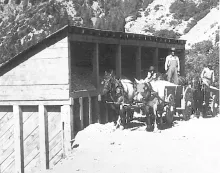
A 1926 photograph of horse-drawn wagons hauling ore at the Questa Mine, published in the Questa News mine history series.

Few great industries begin with a case of mistaken identity, but Questa's mining story does. In Sulphur Gulch, the ground held a soft black mineral and a yellow earth, and for a long time nobody knew what they really were. The black mineral was thought to be graphite, and the yellow earth was thought to be sulfur, the very substance that gave the gulch its name.

  • Read more about Sulphur Gulch: The Mistaken Mineral That Launched Questa's Mine

Pagination

  • Page 1
  • Next page ››
Subscribe to New Mexico History

Copyright © 2026 Rocky Mountain Madman LLC - All rights reserved

Developed and Designed by Rocky Mountain Madman LLC