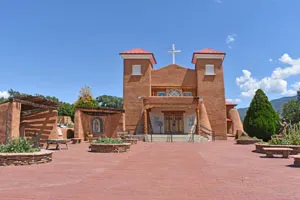
Did you know Questa's church began in the same year as the village itself? When 35 families received possession of the San Antonio del Rio Colorado land grant in January 1842, the village they founded took its name from Saint Anthony — San Antonio del Rio Colorado, Saint Anthony on the Red River. Construction of the San Antonio church began that same year, in 1842, and the first baptism records from Rio Colorado date to 1842 as well. This was no quick building project. The church would take years to finish, and that long, patient work is part of its story.
The first families built on the mesa rather than down along the river, and a wall was built around the plaza for protection. At the center of that plaza, work on the thick-walled adobe church went on through the mid-1840s and into the late 1850s. These were sheep farmers and traders holding a remote settlement together, and they raised their church the same way they raised their homes — by hand, with local earth and local timber, a little at a time, season after season.
The clearest picture of that work comes from 1855. That year, ponderosa pine trees were harvested on Flag Mountain, the peak that watches over the village, to make the roof vigas for the San Antonio church — the heavy wooden beams that carry a flat adobe roof. Mules were used to skid the logs down the mountain to Questa, and when the slope or the load demanded it, some of the vigas were carried by hand by the men themselves. Imagine that line of neighbors, timber on their shoulders, bringing the roof of their church down the mountain piece by piece.
By 1860, the long effort had its reward. Bishop Lamy, visiting Rio Colorado that year, noted the beautiful new church on the north side of the plaza. Beautiful is the word that stayed with it. From a building site that had stretched across nearly two decades, the village now had a finished church at its heart — a place for baptisms, weddings, feast days, and funerals, and the anchor around which village life turned.
Later generations kept adding their own marks. In 1899 the church got a roof renovation, and workers left a quiet signature behind: names were later found written on the ceiling boards, dated 1899. Photographs tell the next chapter — a 1943 photograph shows a single central bell tower, while a photograph from 1950 shows two bell towers. The building kept changing in small ways, always cared for by the families who worshipped inside it.
That is why the church still feels like more than a building when you stand on the old plaza today. Its vigas came down Flag Mountain on mules and on men's shoulders. Its walls rose slowly, across the same years when the village itself was learning how to survive. San Antonio de Padua — Saint Anthony's — has stood at the center of Questa since the mid-1800s, and it still serves parishioners today, a church built by a village, for a village, one beam at a time.