Sunday, November 1, 2026
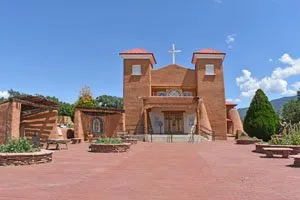
Rain is falling over the valley this Sunday, with a high near 55 degrees, rain likely through the day, and sunset coming early at 5:05 PM now that the clocks have gone back. It is a good day to slow down, stay close to home, and look again at the place that has stood at the center of Questa longer than the village has carried its present name: the thick-walled adobe church on the old plaza, St. Anthony's.
Questa was officially founded in 1842 as San Antonio del Rio Colorado. The land grant that became the village was first requested from Mexico in 1841, and the petition was granted to 35 families in January 1842. A wall was built around the historic plaza to protect the young settlement of sheep farmers and traders, and the church rose at its center, giving the village its original name, Saint Anthony on the Red River. The wall is gone now, but the church has stood at the heart of the community since the mid-1800s.
The name Questa arrived later, and by accident. In 1883, when a United States post office was established, the name was meant to become Cuesta, Spanish for a slope or ridge, a fitting word for a village built on inclines. The postmaster's spelling, Questa, is the name that stayed. The families who founded the village are still familiar here today. Among the earliest family names were Rael, Cisneros, Ortiz, Armenta, LaForet, Kronig, Cruz, Beubien, Vigil, Trujillo, and Gallegos, and some of those same families continue to lead the village now.
That continuity showed most clearly when the church needed its people most. When the west wall of St. Anthony's collapsed, descendants of the families who had built the church in the 1800s rebuilt it. Hundreds of community volunteers worked for six years, one adobe brick at a time. Volunteers gathered on Saturday mornings for community workdays, a crew of about ten residents kept at it on weekdays, and local partners helped choose and fell trees for new timbers, milling and hand-carving them, while craftspeople made new stained glass. The reconstruction was completed in 2012, and today the restored church stands re-consecrated at the heart of Questa, open during daylight hours and welcoming to all guests.
Village life still runs on older rhythms as well. Alfalfa, hay, and winter wheat are still grown in the valley, watered by acequias fed from the Red River and Cabresto Creek. The ditch associations, including the Acequia Madre and the Llano ditch, carry both water and community with them, and the burning of the ditches on the first weekend after the spring equinox remains a major community event each year.
So on this wet first Sunday of November, consider this an invitation to know the village a little better. Walk the old plaza in the rain if you are nearby, look up at the church the founding families built and their descendants rebuilt by hand, and remember that Questa's history is not behind glass here. It is still standing, still open, and still tended by the people whose names have been part of this valley since 1842.