Skip to header Skip to main navigation Skip to main content Skip to footer

Search form

Home
Questa New Mexico

Main navigation

  • Home

New Mexico History

Breadcrumb

  • Home
  • New Mexico History

Questa Rallied to Save San Antonio del Rio Colorado Church
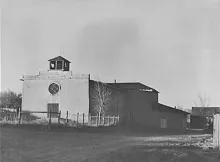
John Collier Jr.'s 1943 photograph of San Antonio del Rio Colorado Church in Questa, New Mexico.

In Questa, a church is more than a building. San Antonio del Rio Colorado Church has long stood at the heart of village life, a place where families gathered for worship and marked the passages of life together. That is why what happened around 2008 hit the community so hard: the historic adobe church partially collapsed.
  • Read more about Questa Rallied to Save San Antonio del Rio Colorado Church

El Pueblito: The Ancestral Village Beneath Questa

The mouth of Red River Canyon near Questa in autumn, photographed by Kent G. Budge.

One of Questa's oldest stories lies quietly beneath its VFW Cemetery. There, on a hilltop at the mouth of Red River Canyon, above the Red River and Cabresto Creek, sits El Pueblito, an ancestral village whose heaviest years of life ran from 1150 to 1225, some eight centuries ago.

  • Read more about El Pueblito: The Ancestral Village Beneath Questa

Watchmen on Sentinel Peak and Flag Mountain Guarded Early Questa

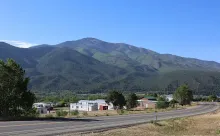
Flag Mountain rising above Questa, New Mexico, photographed from New Mexico State Road 522 just north of the village.

Look up from Questa and you will see two high sentinels of stone: Sentinel Peak and Flag Mountain. Their names are not accidents of poetry. They remember a time when the survival of a small settlement depended on watchful eyes posted high above it.

The settlement was founded as Rio Colorado in 1842, after a grant to 35 families. Thirty-five families is a village, but a small one, and those families were planting their lives in an exposed place. Everything they built, planted, and raised depended on their ability to see trouble coming in time to respond.

  • Read more about Watchmen on Sentinel Peak and Flag Mountain Guarded Early Questa

Old Red River Pass: The Road That Opened the High Country

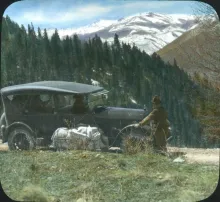
A 1920s Dodge touring car on the old Red River Grade, with snowy peaks behind the pines.

Before 1915, getting over Red River Hill was an ordeal that wagon drivers planned their whole trip around. The old road climbed at grades as steep as 27 percent, far beyond what a loaded wagon could safely descend on its own brakes. Drivers coped the frontier way: they cut a log, chained it behind the wagon, and dragged it down the mountain as a brake, trusting friction and timber to keep them alive.

  • Read more about Old Red River Pass: The Road That Opened the High Country

The Questa History Trail: A Village Tells Its Own Story

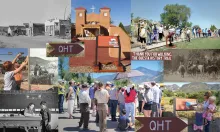
A Questa Creative Council collage of Questa History Trail photographs showing the church, interpretive signs, red arrows, and walkers.

Some history lives in books, and some of it you can walk. The Questa History Trail belongs to the second kind. It is a living history project built by the people of Questa themselves, turning the streets and plaza of their own village into an open-air story of where they come from.

  • Read more about The Questa History Trail: A Village Tells Its Own Story

The 1941 Moly Tunnel: A Mile Through the Mountain at Questa

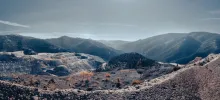
Panorama of the Questa molybdenum mine area in May 2022, showing the terraced workings below the mountains.

By 1941, the molybdenum workings above Questa had chased their high-grade veins deep into the mountain, about 260 meters down. Ore that deep is expensive to move, water down there is expensive to drain, and air is expensive to keep fresh. The mine's answer was ambitious: drive a tunnel a full mile long, north from Red River Canyon, straight to the deepest workings.

  • Read more about The 1941 Moly Tunnel: A Mile Through the Mountain at Questa

Francisco Laforet: The Trapper Who Helped Settle Questa

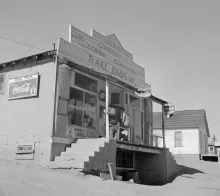
John Collier Jr.'s 1943 photograph of the Rael Bros. general store in Questa, New Mexico.

Every community has a figure who seems to stand at a crossroads in its story, and for Questa that figure is Francisco Laforet. He was a French-Canadian trapper, born in Montreal, whose life carried him from Canada to the mountains and rivers of northern New Mexico, where his name became woven into the founding of the village first known as San Antonio del Rio Colorado.

  • Read more about Francisco Laforet: The Trapper Who Helped Settle Questa

The Plazuelas: How Questa's First Families Built Their Village

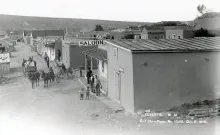
Questa's main street on October 6, 1910, in O.T. Davis's photograph, with wagons, the post office, and the saloon.

Questa's founding story begins on the trail. As Tessie Rael de Ortega told it, the first settlers walked the south Kiowa Trail driving their sheep, and when they made camp at the Rio Colorado, they gave their new home a name around the fire: San Antonio del Rio Colorado. It was a name spoken before a single building stood, a promise the families made to a place.

  • Read more about The Plazuelas: How Questa's First Families Built Their Village

Voces de Nuestro Pais: Questa's Elders Tell Their Stories

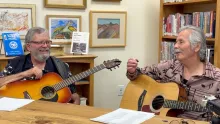
Billy and John Archuleta of Des Montes perform with guitars at a Voces de Nuestro Pais gathering at the Questa Library.

History in Questa is not only found in old buildings and photographs. It is also sitting in the memories of the village's elders, and a project launched in fall 2025 is making sure those memories are gathered, honored, and kept. It is called Voces de Nuestro Pais, which means Voices of Our Area.

  • Read more about Voces de Nuestro Pais: Questa's Elders Tell Their Stories

Father Pat Smith and the Bridge He Tore Down

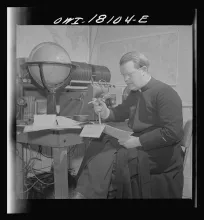
Father Pat Smith broadcasting from the parish house in Questa in John Collier Jr.'s 1943 photograph.

When Monsignor Glenn Patrick Smith arrived in Questa in 1942, he became the village's first resident parish priest, and he wasted no time making an impression. Father Pat Smith, as he was known, brought an energy to the parish that people in Questa were still talking about generations later.

The most famous story comes from John Collier's 1943 account of the priest's early work in the village. Smith took an axe to the only bridge out of town. His reasoning, delivered as he swung, was disarmingly practical: "If I don't tear down the bridge, it'll fall down."

  • Read more about Father Pat Smith and the Bridge He Tore Down

Pagination

  • Previous page ‹‹
  • Page 2
  • Next page ››
Subscribe to New Mexico History

Copyright © 2026 Rocky Mountain Madman LLC - All rights reserved

Developed and Designed by Rocky Mountain Madman LLC