Before 1915, getting over Red River Hill was an ordeal that wagon drivers planned their whole trip around. The old road climbed at grades as steep as 27 percent, far beyond what a loaded wagon could safely descend on its own brakes. Drivers coped the frontier way: they cut a log, chained it behind the wagon, and dragged it down the mountain as a brake, trusting friction and timber to keep them alive.
Local people decided the country deserved better. In March 1914, the Good Roads Association was organized to push for a real road, and Sylvester Mallette, a name still familiar in the Red River valley, served as one of its officers. The campaign was about more than convenience; a safe pass meant supplies, mail, visitors, and a future for the mountain communities.
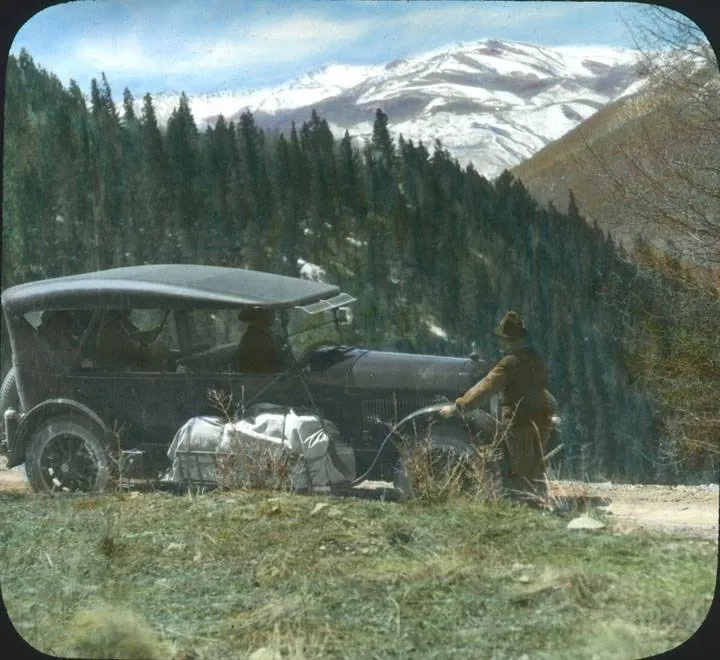
The Forest Service took on the building. Construction of the new pass began in June 1915 and ran through the summer of 1916, and much of the work was done by hand. Among the crews were men from Taos Pueblo, whose labor helped carve a road through country that had defeated wagons for years.
The engineering standard tells the story of the improvement. Where the old road pitched at up to 27 percent, the new pass held its grades to 7.5 percent. That difference was the difference between a descent that required a dragging log and a road an automobile could climb and descend with confidence. The new pass gave the country its first safe automobile access to the high valley.
The hand-built pass served for nearly half a century. It was finally replaced when Bobcat Pass was built between 1962 and 1966, giving modern traffic a still better line over the divide. But the old road was not erased. Its switchbacks survive today as Forest Road 488, used as a hiking and off-road trail, where old aspen carvings mark the route and reward those who travel it slowly.
That afterlife feels right for this road. Built by hand to open the country to a new machine age, the old pass now belongs to walkers and drivers who take it for pleasure rather than necessity. The log-dragging wagons are long gone, but the grades the Forest Service crews cut into the hillside still carry travelers over Red River Hill, just as they first did in 1916.