
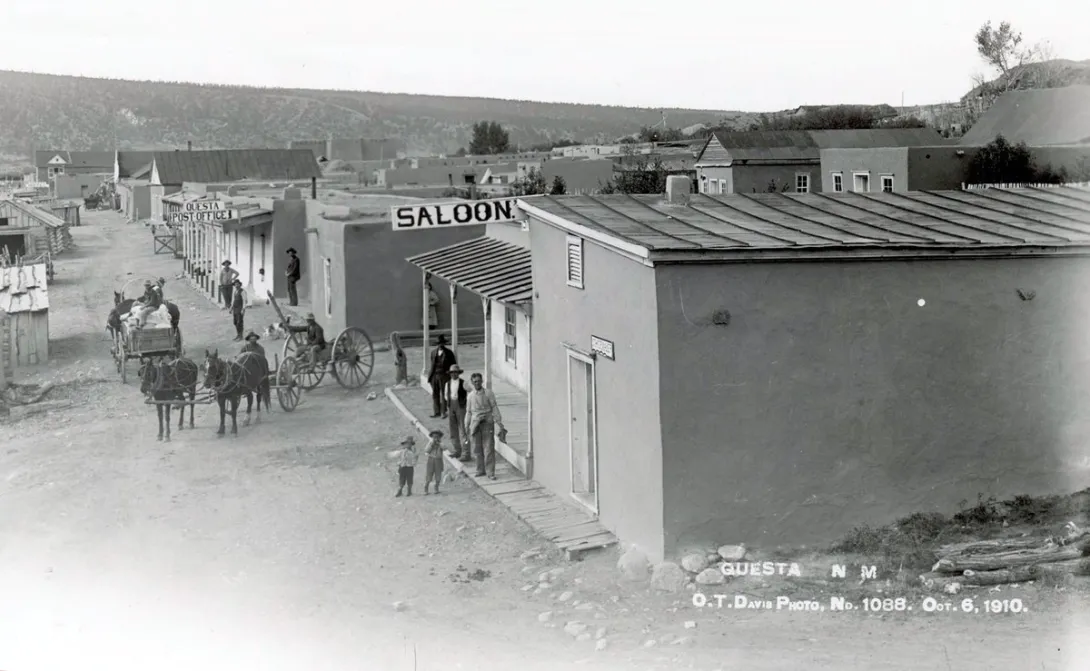
Questa's founding story begins on the trail. As Tessie Rael de Ortega told it, the first settlers walked the south Kiowa Trail driving their sheep, and when they made camp at the Rio Colorado, they gave their new home a name around the fire: San Antonio del Rio Colorado. It was a name spoken before a single building stood, a promise the families made to a place.
The work started the very next day. First the settlers built huts for shelter. Then they began building proper houses on the mesa along what is now Cabresto Road, putting down roots in the ground above the river that would sustain them.
The form those homes took tells you how frontier families survived. Rather than scattering individual houses, the families built four plazuelas, U-shaped walled compounds arranged around open yards. The walls offered protection, the yards held the livestock that fed and supported each family, and inside the compounds were halls used for fiestas and dances, because celebration was built into the architecture too.
A plazuela was a small world unto itself: animals close at hand, family all around, and a hall ready when the music started. Yet the four compounds were not isolated from one another. Each plazuela invited the others to visit, so the young settlement was a network of related households, bound together by kinship, faith, work, and dance.
Geography anchored the little colony. The Gallegos plazuela, for example, stood at the mouth of Cabresto Canyon, a position that tied the settlement to the canyon country behind it as well as the river below. Each family chose its ground with the practical eye of people who intended to stay.
The founding families' names still echo through the Questa area today: Armenta, Lafore, Gallegos, Vigil, Martinez, Cisneros, and Rael. When you hear those surnames in northern Taos County, you are hearing the roster of the people who walked the Kiowa Trail, camped at the Rio Colorado, and decided to build.
San Antonio del Rio Colorado would eventually become the Questa we know, but its first shape was four U-shaped compounds on a mesa, part fortress, part farmyard, part dance hall. That combination, practical, faithful, and joyful, is still a fair description of the village those families founded.