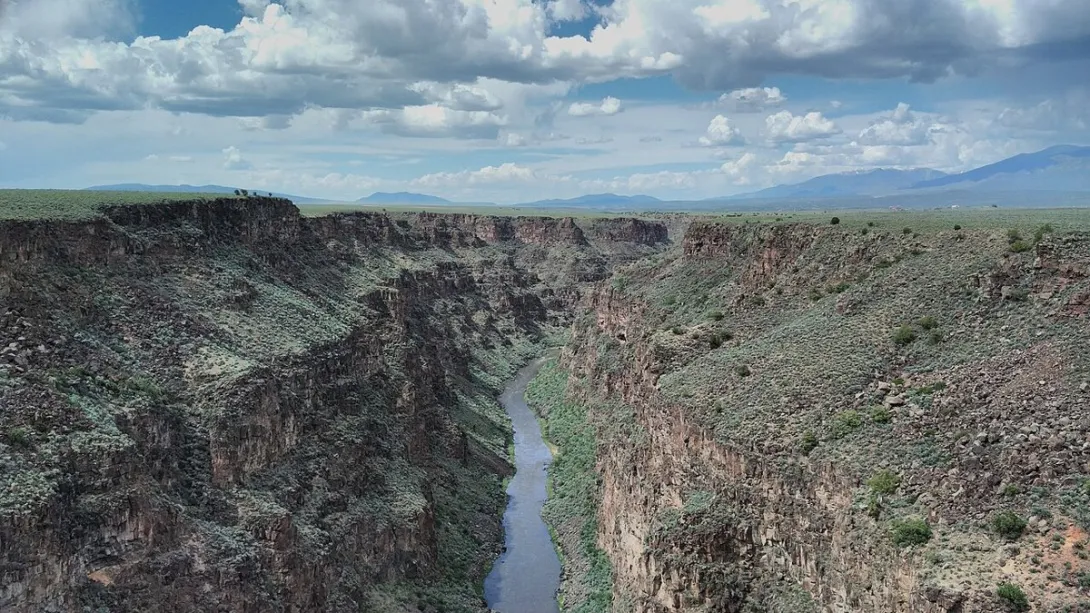
West of Questa, the land opens into the broad Taos Plateau, and then, almost without warning, it drops away. At the Wild Rivers Recreation Area, where the Red River meets the Rio Grande, you can stand at the rim and look into a gorge the Bureau of Land Management describes as up to 800 feet deep, carved through layers of volcanic basalt flows and ash interbedded with sand and gravel. The dark rock in those walls has a name every local rockhound should know: Servilleta Basalt.
Click to see more photos of Servilleta Basalt and the Rio Grande Gorge
The story begins with the Rio Grande rift. Geologists with the New Mexico Geological Society describe a 26-million-year history for the rift in the Wild Rivers country, beginning with early rift-related rhyolitic volcanism, the same episode associated with the Questa caldera, before the Sangre de Cristo Mountains rose and Santa Fe Group sediments filled the sinking basin. Much later, in Pliocene time, fluid lava spread across the Taos Plateau in flow after flow of Servilleta Basalt, building the flat, sage-covered surface you drive across today, dotted with volcanic cones.
Only after that lava plain was in place did the rivers go to work. The Rio Grande and the Red River cut down through the plateau, exposing the stacked flows in the gorge walls. Near the confluence at La Junta Point, those layers read like pages: dark basalt benches separated by paler basin sediment, with broken blocks of basalt gathered on the slopes below the rim. It is one of the clearest places in northern New Mexico to see, in a single view, how volcanism built the land and how a river unbuilt it.
For rockhounds, Servilleta Basalt is a lesson in reading a rock before ever picking one up. It is a dark, fine-grained volcanic rock, hardened from low-silica lava that flowed easily and spread widely. In the gorge country, field geologists have noted flow features in it, including stretched bubble holes, called vesicles, left by gas escaping as the lava cooled. Learning to recognize that black, dense basalt, and to tell one flow layer from the next, is the foundation for understanding almost every other rock story around Questa, from rhyolite in the mountains to the gravels the river carries today.
This is a feature to enjoy with your eyes, a camera, and a notebook. The gorge, the Wild Rivers Recreation Area, and the Rio Grande del Norte National Monument around them are protected, much-loved public country, and they are a place for looking and learning, not for collecting. The reward here is bigger than a single specimen: once you can read the Servilleta layers at the rim, every drive across the plateau and every hike to an overlook becomes a geology walk.
Know before you go: Collect only where it is legal, and never assume it is. The Bureau of Land Management says rockhounds may collect reasonable amounts of rocks and mineral specimens for personal use on some BLM lands, using hand tools with only minor surface disturbance, but collecting is not allowed in developed recreation sites such as picnic areas and campgrounds unless otherwise permitted, and collecting on an existing mining claim is prohibited without the claim holder's permission. Private land requires the landowner permission, and cultural sites and artifacts are protected and must be left alone. This article names no collecting site, because no specific site near Questa was verified as open to collecting for this feature. Before collecting anywhere, check with the BLM Taos Field Office, respect posted signs, pack out what you pack in, and leave the gorge country exactly as you found it.