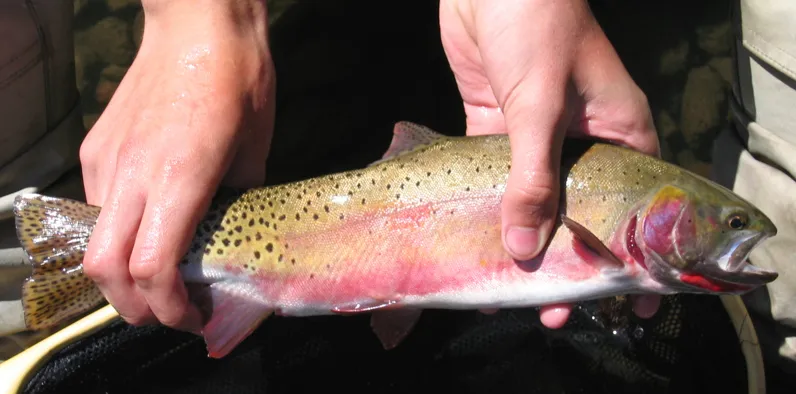
Did you know some of the trout in the Rio Grande below Questa arrived there in a backpack? Once a year, starting in 2008, volunteers have carried Rio Grande cutthroat trout fingerlings down the steep trails of the Rio Grande Gorge and released them into the river. The New Mexico Department of Game and Fish describes the stocking as a unique endeavor that relies on multiple agencies and on the public, whose members carry a bag, or sometimes two, filled with the state fish down scenic yet steep sections of the gorge so that about 5,000 young trout can reach their natural habitat.
Click to see more photos of the Rio Grande cutthroat trout — the fish, its waters, and stocking by backpack »
The fish at the center of the work carries a long history in these waters. The Rio Grande cutthroat trout is New Mexico's state fish, and Department coldwater biologist John Smith has described the project as conserving a native state fish back on the landscape in a river where it historically would have been the only trout species. The fingerlings begin their journey at the Department's Seven Springs fish hatchery near Jemez Springs, where they are raised until they are about a year old. In an earlier account, the Department noted that Seven Springs raised only this species, so that the cutthroat's genetic strain would stay pure.
The last part of the journey is the hardest, and it can only be done on foot. These sections of the Rio Grande are accessible only by hiking, so volunteers are essential. In March 2014, when the Department planned to stock almost 10,000 fingerlings, it explained that each volunteer would carry a bag filled with three to four gallons of water containing more than 100 live fingerlings. The bags were tied off, loaded into backpacks, and hiked down to the river, where the fish were acclimated to the river's temperature before they were released. The river lies 800 feet below the rim, and the trails to the bottom vary in length from less than a mile to a mile and a half.
Anglers, schoolchildren, and cutthroat enthusiasts were among the volunteers in 2014, and they gathered at the La Junta Trailhead in the Wild Rivers Recreation Area, above the place where the Red River joins the Rio Grande. The Department said then that anglers made the program possible not only by volunteering, but also by funding it through license fees and through an excise tax on fishing equipment, rods, and boat fuel under the Sport Fish Restoration Act. By that year, fish stocked as fingerlings had grown to adulthood in the gorge and measured as large as 10 to 12 inches, and anglers were asked to report the cutthroats they caught so that biologists could judge how well the reintroduction was working.
The work continues with a wide circle of partners, including the Bureau of Land Management, the Rio Grande del Norte National Monument, Trout Unlimited, the United States Forest Service, and Friends of the Rio Grande del Norte. For Questa, the stocking ties the village's fishing heritage to the protected country just west of town, where the Wild Rivers trails drop from the rim to a river that was once home to this trout alone. Each spring's careful hike down, and the harder climb back up, is a reminder that some heritage is kept not in a building or a book, but in living water.