
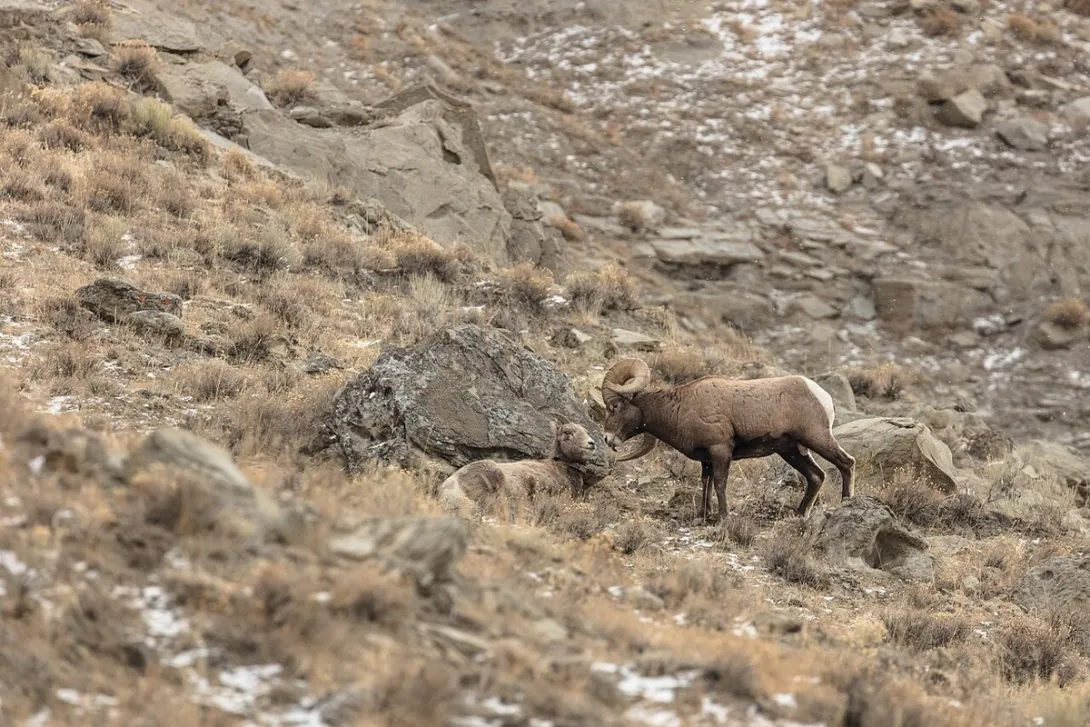
High above the Rio Grande north of Questa, a ram picks his way across a cliff face that looks impossible to walk, stops, and surveys the canyon below. He is a Rocky Mountain bighorn sheep, and his herd is one of the great wildlife comeback stories in northern New Mexico. The Bureau of Land Management lists bighorn sheep among the watchable wildlife at the Wild Rivers Recreation Area in the Rio Grande del Norte National Monument, where the Rio Grande and Red River meet in an 800-foot-deep gorge and sheep move between the river corridor and the open rim country above.
Click to see more photos of Rocky Mountain bighorn sheep
That presence is recent. Bighorn sheep were eliminated from much of New Mexico in the early 1900s by unregulated hunting and disease spread from domestic sheep, and for decades the gorge held none at all. The herd returned in 2006, when Taos Pueblo translocated 23 sheep from the Wheeler Peak area, followed in 2007 by 25 more released by the New Mexico Department of Game and Fish from the Pecos Wilderness. State biologists now estimate the Rio Grande Gorge herd at several hundred animals, a healthy, self-sustaining population watched over by the Department, Taos Pueblo, and the Bureau of Land Management.
November is the most dramatic month to think about them. In the southern Rockies the bighorn rut, or breeding season, runs from late October through late December and peaks from about mid-November to mid-December. Rams that spent much of the year in bachelor groups join the ewes, size each other up, and settle rank by rearing and charging head-first into one another, horns meeting with a crack that can carry across a quiet canyon. The lambs that result from this season will be born the following spring, from late April into June, on steep ground where predators are at a disadvantage.
For visitors, the best approach is patience and optics. Scan the gorge walls, benches, and rim meadows from established overlooks and trails at Wild Rivers, including the country around La Junta Point above the confluence, and from other developed viewpoints along the gorge. The sheep's tan coats blend remarkably well with basalt and sagebrush, so a careful look through binoculars often reveals an animal that was there all along. Early morning and late afternoon light helps, and a second, slower scan is always worthwhile.
Know before you go: Watch bighorn sheep from a respectful distance and let them choose how close to come. Never feed wildlife, and stay on roads, trails, overlooks, and other established recreation areas rather than following a herd cross-country. Give rams extra room during the November and December rut, when they are focused and unpredictable. Sensitive exact locations are intentionally not shared here, because these are wild animals, not exhibits. Bring binoculars, stay back, and enjoy the privilege of seeing them on their own terms.