
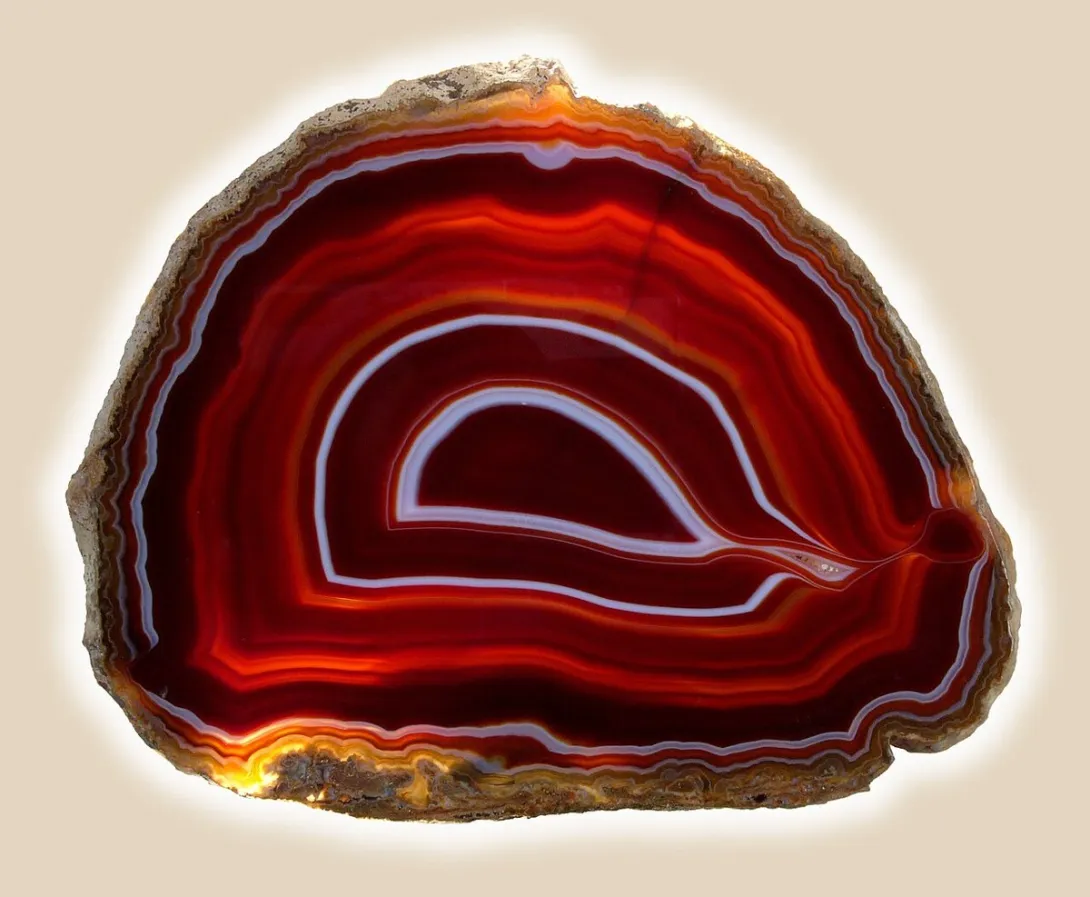
Some of the most eye-catching stones in the volcanic country around Questa are not large crystals at all. They are agate and jasper, colorful pieces that reward a close look. The United States Geological Survey notes that varieties of agate, jasper, chert, and petrified wood are found in fifteen of New Mexico's thirty-two counties, and our corner of Taos County, shaped by the Rio Grande rift and its basalt and rhyolite flows, is exactly the kind of volcanic terrain where silica-rich stones form. Learning to tell the two apart is a fine first skill for any beginning rockhound.
Agate and jasper are close relatives. Both are chalcedony, a form of quartz made of crystals so small they cannot be seen with the unaided eye, which is why the stones look smooth and solid rather than sparkly. The difference is mostly about light. Agate is translucent and usually shows fine, curved bands in layers of different colors. Jasper is opaque, so light does not pass through it at all, and it is often colored in solid reds, yellows, and browns by tiny grains of other minerals caught inside it.
The story begins in cooling lava. As rhyolite and basalt flows hardened, they trapped gas bubbles and cracks. Later, water carrying dissolved silica moved through the rock and lined those openings, layer by layer. Research published through the New Mexico Bureau of Geology and Mineral Resources describes chalcedony nodules forming this way inside rhyolite flows, with banding produced as silica-rich fluids filled open spaces over time. Iron compounds in the water tinted some layers deep red or warm orange, while cleaner silica left pale, milky bands. A broken nodule can therefore read like a small record of the water that once moved beneath a volcano.
A simple test separates the two stones at home. Hold a thin edge up to a strong light or a flashlight. If light glows through the edge, you are looking at agate or chalcedony. If the edge stays completely dark and the color is strong and solid, it is most likely jasper. Hardness will not settle the question, because both stones are quartz, at about seven on the Mohs scale, hard enough to scratch glass and to resist a steel knife. Both also break with a smooth, curved, glassy fracture and leave a white streak, so the light test remains the clearest guide.
For beginners, identification practice is half the pleasure. Compare a banded, glowing piece with a solid red one side by side, turn each in good daylight, and note how differently they handle light. That habit trains the eye for every other mineral in these hills, from the clear quartz we featured last week to the dark basalt of the gorge. A careful look, a notebook, and a photograph can turn a single interesting stone into a lasting lesson in how this landscape was made.
Know before you go: Collect only where it is legal. On Bureau of Land Management land, rockhounds may collect reasonable amounts of rocks, minerals, and gemstones for personal use only, not for sale or barter, using hand tools and causing no more than minor surface disturbance. Do not collect in developed recreation sites such as picnic areas and campgrounds unless collecting is specifically permitted there, and never collect on a mining claim without the claim holder's permission. Respect private land and posted closures, check with the local land manager when you are in doubt, and pack out everything you pack in. Photograph: a banded agate slice by Hannes Grobe, via Wikimedia Commons, used under a Creative Commons license.