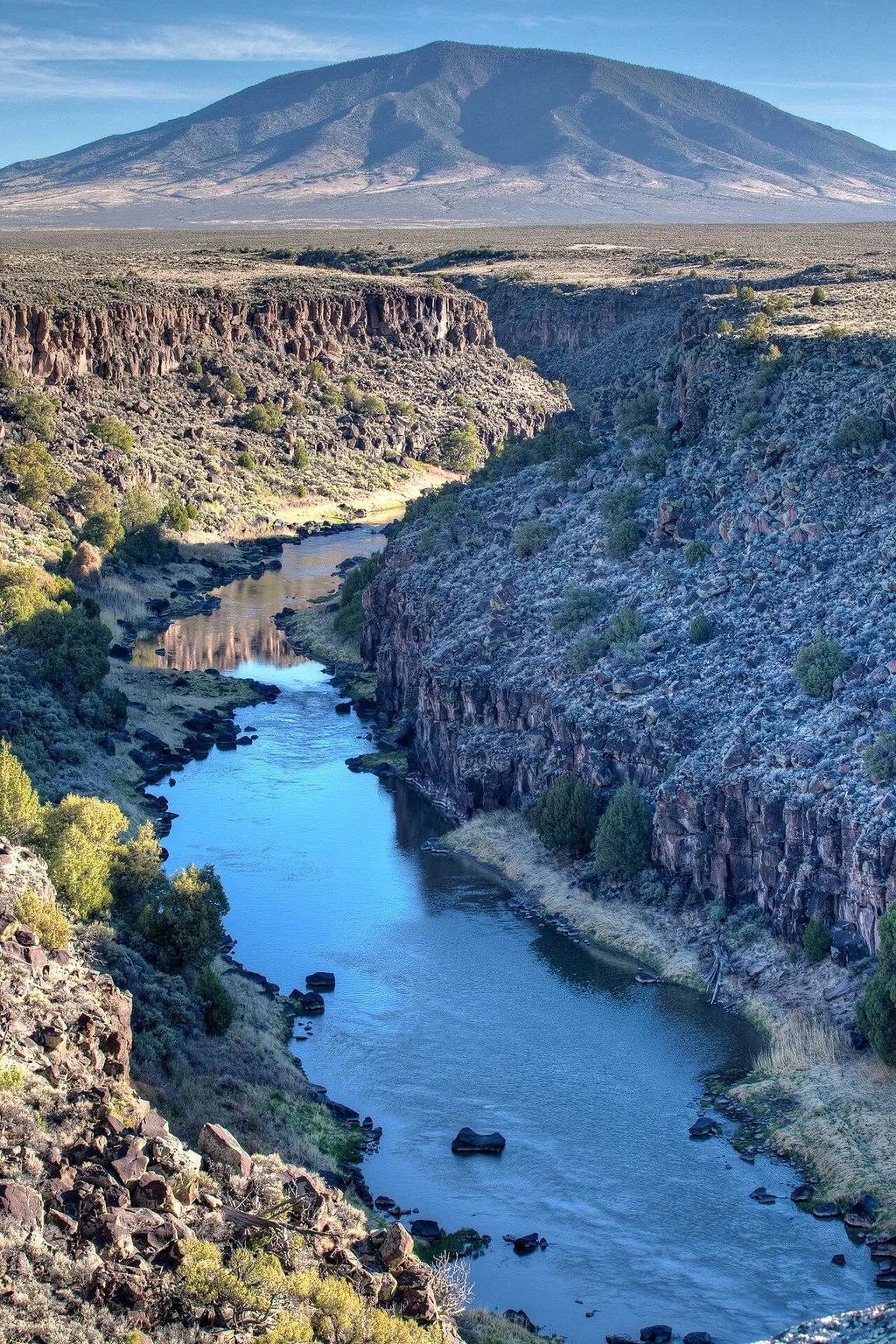
Did you know that one of the best-known place names in Questa ranching country still remembers sheep, even though the sheep are long gone? For generations, cattle in and around Questa have followed the seasons across the high valley. The herds graze on the plains north and west of town during the winter and spring, and then, in early June, they are moved west to the other side of the Rio Grande, usually driven across the ford called the Sheep Crossing by riders on horseback.
Click to see more photos of the Rio Grande country west of Questa — the gorge, Ute Mountain, and the plains the herds cross »
That seasonal rhythm began with sheep and goats. Around 1800, Hispanic settlers from Taos began moving north in search of new grazing land for their flocks, and between 1805 and 1818 the first Questa-area settlers traveled to the Rio Colorado country on the Kiowa Trail, driving their sheep with them. By 1835, families were coming to Questa from Taos to farm and to graze sheep in the summers, learning a country where the grass, the creeks, and the calendar all had to be read together.
Farming and herding were never separate lives in the young village. The wall that was built around the historic plaza offered protection to a fledgling settlement of sheep farmers and traders, and the families inside it depended on both their fields and their animals. The Questa History Trail timeline records the area's first water rights in the years from 1808 to 1815, because in this dry, high country a flock or a crop was only ever as secure as the water that sustained it.
That truth still shapes agriculture in Questa, which remains strongly dependent on irrigation supplied from the Red River and Cabresto Creek. In 1912, the year New Mexico became a state, the Llano Irrigation Company was formed. Today, two major ditch associations, the Acequia Madre and the Llano ditch, control the distribution of water by controlling the outflow from the Cabresto Lake dam, sharing the creek's flow among the fields and pastures it has watered for generations.
Over time, the animals themselves changed. The traditional sheep herds have mostly been replaced by small herds of cattle, and the old Sheep Crossing name outlived the flocks that gave it its name. The fields changed more slowly. Alfalfa, hay, and winter wheat are still grown in the Questa valley, and some grain and even cattle are now certified to supply a growing market for organic goods.
So the valley still works by the seasons its first families learned. Winter and spring belong to the open plains north and west of the village, early June belongs to the ride across the Rio Grande, and the ditch water and the hay and wheat fields belong to everyone who shares them. It is a ranching and farming heritage that was never only about livestock or crops. It was, and remains, about a whole community moving in time with its land and its water.