Did you know that Questa began with a handful of grass? On January 19, 1842, thirty-five families gathered on the land along the Rio Colorado, the river now called the Red River, and took formal possession of their new village. As the law required, the settlers threw a piece of sod to show possession. Then, in the words of the official record, they pulled out grass and shouted with joy, "Long live the sovereign powers of the Mexican nation and the constituted authority." With that shout, San Antonio del Rio Colorado was founded.
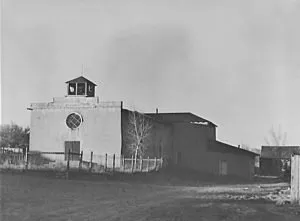
Click to see more photos of San Antonio Church and old Questa — the 1943 church, the village streets, and the valley today
The ceremony closed eleven days of paperwork. On January 8, 1842, Rafael Archuleta, Antonio Elias Armenta, and Miguel Montoya filed a petition on behalf of the thirty-five families with Don Juan Andres Archuleta, Prefect of the First District of the Department of New Mexico. The settlers wrote that they found themselves "in want of land for the support of our families," and that public lands should go to those who would develop them for agriculture, because the land they asked for at El Rio Colorado was very fertile. On January 19, Don Juan Antonio Martin, Justice of the Peace, walked the land with two witnesses, Juan Andres Lovato and Jose Antonio Gutierrez, found it free and public, and delivered possession in a document covering approximately 110,000 acres.
Possession came with conditions, and the families answered in a unanimous voice that the orders would be remembered and understood. They had to live on the land, maintain the common lands, keep weapons to defend the settlement, and cultivate the land for four years before any of it could be sold. They also had to fortify the town, so the first plaza rose on high ground as a row of mud-plastered log houses, called jacals, standing side by side around a courtyard closed by a fortified gate. Some land was never divided at all. The meadow in front of the plaza remained for the benefit of all in common, a surplus tract up the Rito del Cabresto was left undistributed, and the pastures and watering places stayed common to everyone.
The name the settlers chose tells its own story. By taking the name of Saint Anthony for their village, the founders mirrored the religious and social values that would hold the settlement together under difficult conditions, and construction of the San Antonio church began that same year, in 1842. The paperwork was not quite finished, either. In February 1842 the government replied that the families could remain in possession while the Departmental Assembly considered the matter, and justices of the peace returned several times in the years that followed to settle boundary questions. On November 11, 1845, the grant was declared legal and valid in all its parts. By 1849, one hundred families were living in the village.
Four decades later, the village received the name it carries today. When a United States post office was established in 1883, the name was changed from Rio Colorado to a word meant to be spelled Cuesta, Spanish for a slope or grade. The Questa History Trail explains that the word pointed to the steep road running up to the village built on the Cabresto mesa, above the old settlers' cabins along Cabresto Creek. The postmaster spelled the name with a Q, and Questa is the name that remained. The grass those thirty-five families pulled in 1842 has long since grown back, but the village they shouted into being is still here.