Sunday, November 15, 2026
Sunday begins quietly in Questa, and that is part of its charm. The morning opened mostly cloudy and cold, near 31 degrees, with no weather alerts for Taos County. The clouds are expected to give way through the morning, turning sunny by midday with a high near 50 degrees. Sunrise came at 6:40 a.m. and sunset follows early, at 4:53 p.m., so it is a short, bright late-autumn day, well suited to an unhurried walk, a visit to the historic plaza, and an afternoon drive out to the gorge before temperatures fall toward the mid-20s overnight.
Every quiet Sunday here rests on a long story. Questa was officially founded in 1842 as San Antonio del Rio Colorado, after its land grant was requested from Mexico in 1841 and granted in January 1842 to 35 families. The early village was a settlement of sheep farmers and traders, and a wall was built around the plaza for protection. That wall is gone, but the thick-walled adobe church that gave the village its first name has stood at the center of the plaza since the mid-1800s. In 1855, ponderosa pines were harvested on Flag Mountain for the church roof vigas, with mules skidding the logs down and some vigas carried by hand, and in 1860 Bishop Lamy noted the beautiful new church on the north side of the plaza.
That church still anchors community life today. When its west wall collapsed, descendants of the families who had built it generations earlier took up the rebuilding, and the restored church was re-consecrated and returned to the heart of the village. It is a fitting symbol for Questa, a place where heritage is maintained by hand by families who still live with the buildings and traditions their ancestors left them. Visitors are asked to enjoy the plaza respectfully, remembering it remains a living place of worship.
Water tells the other half of the village story. Farming here has always depended on irrigation from the Red River and Cabresto Creek, carried through community acequias, the hand-built ditches that still shape northern New Mexico. Each acequia is run by its own community, with a mayordomo overseeing the water and parciantes, the water-rights holders, sharing both the flow and the work. In spring, neighbors gather for the annual ditch cleaning, a tradition as much about community as about water. In mid-November the fields rest, but the green valley the acequias sustain is visible everywhere a Sunday drive turns toward the river.
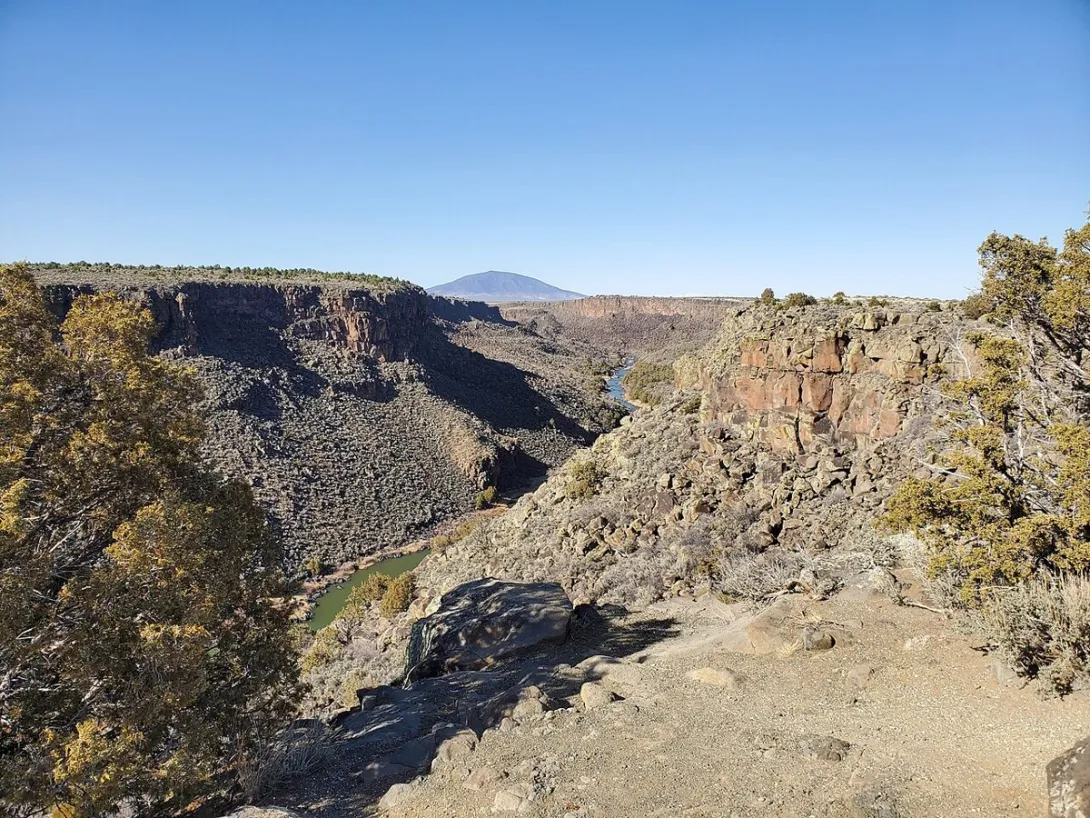
A good Sunday plan ends at Wild Rivers. The Wild Rivers Recreation Area, within the Rio Grande del Norte National Monument west of Questa, protects the deep gorge where the Red River meets the Rio Grande. The Bureau of Land Management lists the Wild Rivers Visitor Center as open daily from 10:00 a.m. to 3:00 p.m., and La Junta Point, one of the most dramatic overlooks in the state, looks down on that confluence. The La Junta Trail remains closed until further notice, and the Bureau asks visitors to respect that closure. La Junta Point Overlook and Campground remain open, and the River Trail and lower canyon can still be reached from the Little Arsenic Springs Trail or the Big Arsenic Springs Trail. Dress warmly for the rim wind and leave time to watch the light move across the basalt walls.
Sunday in Questa rewards those who slow down. This is a village built by hand and held together by faith, water, and family, set between the Sangre de Cristo Mountains and one of the great river gorges of the West.