Did you know that one of the most famous cabins in New Mexico literature began as a homestead on the slopes above San Cristobal, just south of Questa? The 160-acre property now called the D. H. Lawrence Ranch sits at about 8,600 feet on Lobo Mountain, in country the old Kiowa Trail crossed on its way through Lama and San Cristobal toward Taos Pueblo. Long before any writer arrived, Kiowa people camped there, and the Questa History Trail still tells how that ancient route passed through the ranch Lawrence first called Kiowa Ranch.
Click to see more photos of the D. H. Lawrence Ranch — the memorial, the chapel, and the views toward Taos »
The ranch's modern story starts with a homesteader. On March 18, 1893, John L. Craig recorded his declaration of rights to water in the El Rio de Las Gallinas, and on July 19 of that year he received his homestead certificate. Two log dwellings and a small barn rose on the claim. On December 18, 1895, the title passed to Mary McClure, who used the ranch to raise Angora goats. On May 26, 1920, it became the property of Mabel Sterne, the wealthy arts patron soon to be known as Mabel Dodge Luhan.
D. H. Lawrence and his wife Frieda first came to Taos on September 11, 1922, as Mabel's guests, and they spent their first winter nearby at the Del Monte Ranch, just below the future Lawrence ranch, from December 1, 1922, to March 18, 1923. When they returned with the artist Dorothy Brett on March 22, 1924, Mabel offered them the Kiowa Ranch itself. Lawrence refused so large a gift, so Frieda accepted it in her own name, and at his insistence she recompensed Mabel with the manuscript of his novel Sons and Lovers. The couple moved up the mountain on May 5, 1924, taking the larger Homesteader's Cabin while Brett occupied the small one-room cabin.
Lawrence spent only about eleven months at Kiowa Ranch in all, five of them in that first summer of 1924, yet the place changed his work. There he wrote much of his novel St Mawr and began The Plumed Serpent, often working at a small table beneath the great pine still known as the Lawrence Tree, the same tree Georgia O'Keeffe painted in 1929 as The Lawrence Tree. His last stay ran from early April to September 10, 1925, after a serious illness in Mexico, and in his essay New Mexico he wrote that New Mexico was the greatest experience from the outside world that he had ever had, and that it changed him forever.
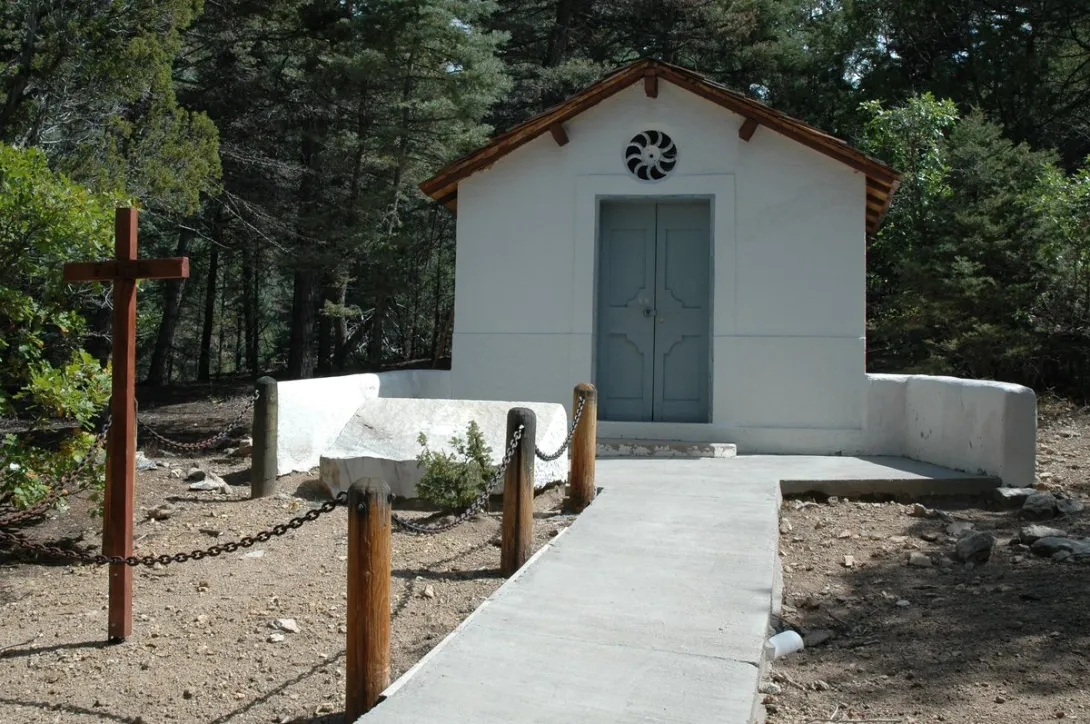
Lawrence died in France on March 2, 1930, and Frieda made the ranch both her home and his memorial. The small chapel above the cabin was built in the summer of 1934, and in April 1935 his ashes, exhumed and cremated in France that March, were brought to the ranch and placed in the chapel altar. Frieda welcomed guests there for years, among them Aldous Huxley, W. H. Auden, Tennessee Williams, and Leonard Bernstein. She died on August 11, 1956, and was buried in front of the chapel, leaving the ranch to the University of New Mexico that same year, and the homesteader's claim on Lobo Mountain was added to the National Register of Historic Places on January 15, 2004.