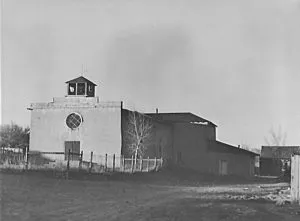
Did you know that Questa's adobe church stood at the heart of the village for a full century before the village ever had a priest of its own? Questa was founded in 1842 as San Antonio del Rio Colorado, and construction of San Antonio Church began that same year on the north side of the plaza. When Bishop Lamy visited in 1860, he noted the beautiful new church there. For generations after that visit, however, the faith that the church represented was carried mostly by Questa's families themselves.
An itinerant priest from Taos made the rounds of the small parishes when the weather allowed, but no resident priest was always available in Questa. The Questa History Trail explains that this was a classic situation in the rural Southwest. After Mexico won independence from Spain in 1821, the Catholic Church removed its priests from the entire region, and laypeople filled the void that was left behind. In village after village, the people kept baptisms, prayers, burials, and feast days alive through their own devotion until a priest could come again.
In Questa, that work fell in large part to Los Hermanos Penitentes, the Penitente Brotherhood. Their full name is Los Hermanos de la Fraternidad Piadosa de Nuestro Padre Jesus Nazareno, the Brothers of the Pious Fraternity of Our Father Jesus of Nazareth. The Questa History Trail describes their way of life as one of deep devotion and simplicity, modeled on living as Jesus lived. Their presence continues to provide a service within communities, taking care of those in need and offering comfort to those in mourning. Local memories tell us that until the mid-1900s, it was assumed that all men in Questa were Hermanos, and that they joined the brotherhood at the age of fourteen.
The Hermanos worshiped in moradas, small adobe structures that were often hard to find or hard to identify. There were three moradas within the village of Questa as it is today. One stood in the south end of the village off Lower Embargo Road, one stood to the east near the historic La Cienega school, and the third stood in Llano. The only surviving morada close by now is in Cerro. All residents could use the village oratorio in the old cemetery across from the historic church, but only the Hermanos worshiped in the moradas, and those small buildings held a faith that did not depend on a resident priest.
Questa's hundred years without a resident priest ended in 1942, when Monsignor Glenn Patrick Smith became the first resident parish priest in Questa. By then, the brotherhood and the Church had lived through periods of conflict, and the Penitentes had at times been ordered to disband and had become a much more secret society. In contrast to that historic conflict, the two practices co-exist today, and Hermanos often lead the procession in church ceremonies to mark Holy Week. The story endures because the people of Questa kept their faith together, in the church on the plaza, in the oratorio, and in three small moradas, until a priest of their own finally came to stay.