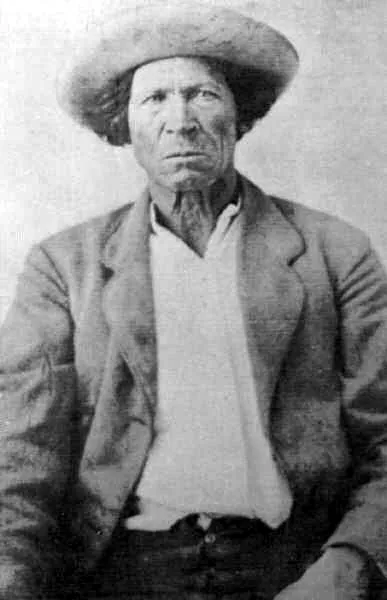
Did you know that one of the earliest settlers in the Questa country hid in plain sight on the village's founding paperwork? When the San Antonio del Rio Colorado land grant was made in 1842, its list of settlers included a man recorded as Carlos Hortuvis. Historians read that Spanish spelling as Charles Autobees, a St. Louis trapper whose life wound through Taos, the whiskey trade, and a farm at La Lama, just south of present-day Questa.
Autobees came west from St. Louis as a young trapper and, by the mid-1830s, had settled in Taos, where he went to work for Simeon Turley, the flour mill and distillery operator on the Rio Hondo famous for Taos Lightning whiskey. Autobees became Turley's traveling salesman and stayed with him for eleven years. He customarily loaded two ten-gallon barrels of whiskey on each mule of a mule train and headed north from Taos through the San Luis Valley, crossed the Sangre de Cristo Mountains at La Veta Pass, and traded the whiskey for buffalo robes and beaver pelts in the Arkansas and Platte river valleys.
His years with Turley ended in violence. On January 20, 1847, during the Taos Revolt that followed the United States invasion of Mexico, Turley and many of his men were killed. Autobees was away on a mule train traveling to Santa Fe at the time, and it fell to him to carry the news of the revolt, and of acting territorial Governor Charles Bent's death, to Bent's Fort. It was the kind of errand the frontier trusted to a man who knew every trail and every people along it.
By then Autobees already held land in the Questa country. In 1845, Governor Manuel Armijo granted Charles and Tom the Cebolla grant at what is now La Lama, to help defend it against the Navajos, Utes, Comanches, and Apaches. The grant was bordered on the north by the Rio Colorado, on the south by San Cristobal Creek, on the east by the mountains, and on the west by the rocky bluffs of the Rio Grande. In July of 1850, Autobees moved up to Rio Colorado to farm his part of the grant. He also guided United States troops, and in March of 1849 he served as a guide and spy for Lieutenant J. H. Whittlesey's expedition against the Utes. His biographer Janet Lecompte called Rio Colorado at that time New Mexico's most northerly, and hence most Indian-plagued, settlement.
Autobees never stayed in one place for long. In 1853 he traveled north with William Kronig, Marcelino Baca, and a party of twenty-five men to settle the Vigil and St. Vrain grant at what is now Pueblo, Colorado, and he spent his last years in Colorado, where he died in 1882. But his Questa chapter endures in the ground itself. The Cebolla grant lands around La Lama and San Cristobal were among the first in this valley entrusted to a newcomer who arrived as a trapper and stayed on as a farmer, a scout, and a neighbor.